
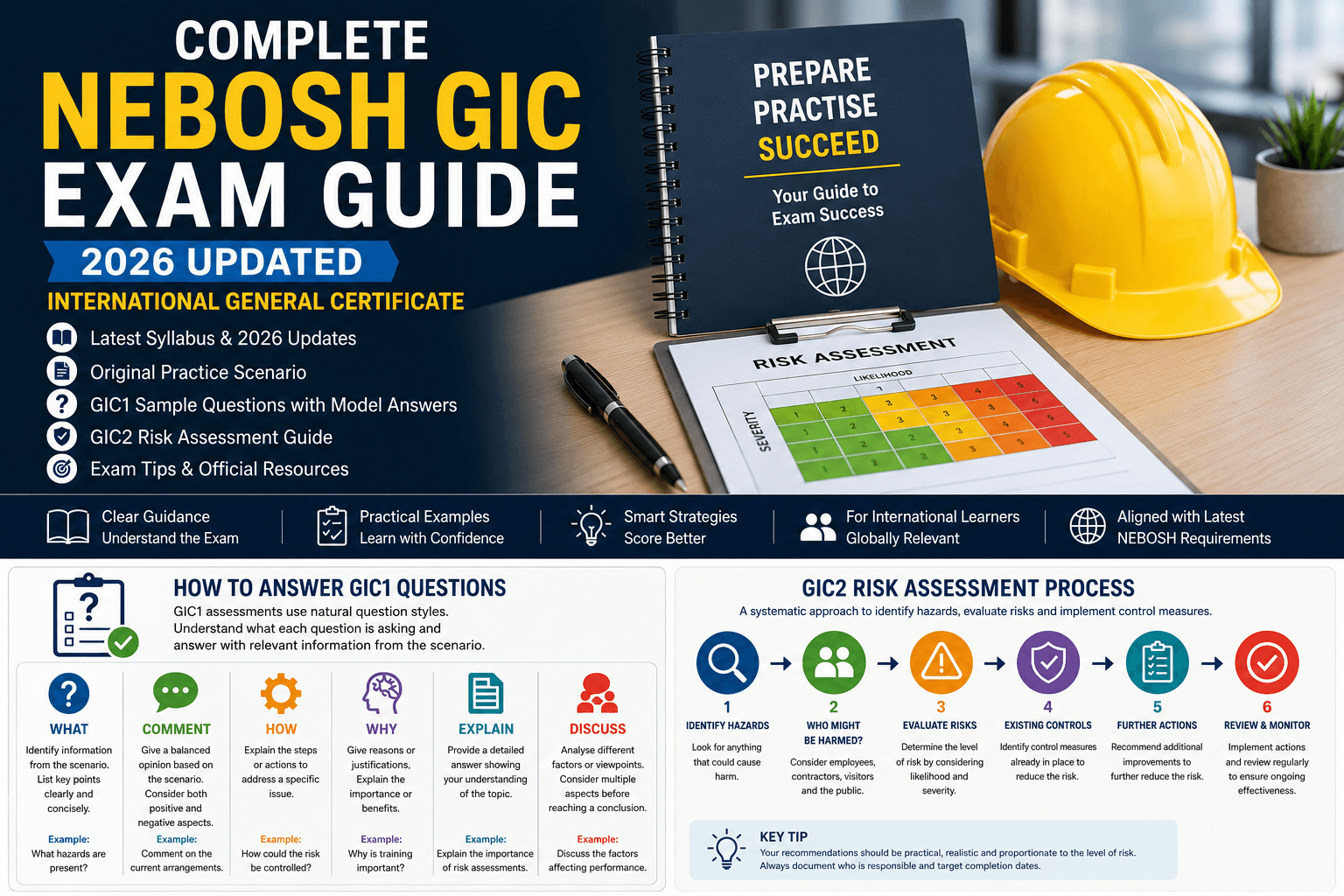
The information in this guide has been prepared using the latest publicly available NEBOSH syllabus and learner guidance. All practice scenarios and model answers included in this guide have been created specifically for educational purposes and should be used alongside the official NEBOSH learning materials.
Table of Contents
What’s New in 2026?
NEBOSH introduced updates to the International General Certificate in Occupational Health and Safety qualification with first teaching from February 2026 and first assessments from March 2026. While the overall qualification structure remains familiar, several changes have been made to improve the assessment process and better reflect modern workplace health and safety practices.
Some of the key changes include:
- The assessment units are now referred to as GIC1 and GIC2 for the NEBOSH International General Certificate.
- Minor updates have been made throughout the syllabus to ensure the qualification reflects current workplace practices and international standards.
- The GIC2 practical risk assessment now uses a points-based marking system with a 60% pass mark, replacing the previous “Met/Not Met” approach.
- Results for both GIC1 and GIC2 are issued together once both assessments have been completed and marked.
NEBOSH GIC Syllabus Overview
The NEBOSH International General Certificate covers the knowledge and practical skills needed to recognise workplace hazards, assess risks, and recommend appropriate control measures. The syllabus is designed to help learners apply health and safety principles across a wide range of industries rather than focusing on one specific sector.
The syllabus consists of 11 elements, which build progressively from health and safety management principles to the control of common workplace hazards.
| S. No. | Elements | Assessment |
| 1 | Why we should manage workplace health and safety | Open book examination (OBE) Unit GIC1: Management of health and safety Elements 1.1, 1.2, 2 and 3 are also assessed by the practical assessment (Unit GIC2) |
| 2 | How health and safety management systems work and what they look like | |
| 3 | Managing risk – understanding people and processes | |
| 4 | Health and safety monitoring and measuring | |
| 5 | Physical and psychological health | Unit GIC2: Risk assessment |
| 6 | Musculoskeletal health | |
| 7 | Chemical and biological agents | |
| 8 | General workplace issues | |
| 9 | Work equipment | |
| 10 | Fire | |
| 11 | Electricity |
Each element introduces key learning outcomes that are assessed through the qualification. Rather than trying to memorise the syllabus, learners should focus on understanding how these topics are applied in real workplace situations, as this is the approach taken throughout the assessment. The passing marks from Unit GIC1 Management of health and safety is 45 marks while Unit GIC2: Risk assessment is 60 %.
How to Answer NEBOSH GIC1 Questions
Recent GIC1 assessments have predominantly used natural question wording such as What, Comment, How, Why, Explain, and Discuss rather old command words used by NEBOSH such as Identify, Give, Outline and etc. Although the wording has changed, the assessment still requires candidates to analyse the workplace scenario, apply health and safety principles, and provide clear, relevant answers.
Practice Scenario
FreshPack Foods Ltd manufactures chilled ready-to-eat meals. The company employs approximately 180 workers across production, warehouse, maintenance, quality assurance and administration. During a morning shift a supervisor observes several developing issues including maintenance work beside an operating production line, partially obstructed emergency exits, an oil leak creating a slip hazard, forklift and pedestrian interaction, faded pedestrian walkways, an agency worker climbing warehouse racking, delayed refresher training, poor near-miss reporting and outstanding corrective actions from previous inspections.
Note: This practice scenario is provided solely for educational purposes and is not an official NEBOSH assessment.
Questions and Answers
The examples below use the practice scenario from this guide to demonstrate the level of detail that is generally expected. You should always answer from the scenario, write positive and negative aspects where required and explain as per the marks assigned to each question.
Question 1 – What unsafe acts or unsafe conditions can you identify from the workplace scenario?
Answer: Unsafe acts and unsafe conditions include:
- Cooking oil leaking onto the floor creating a slip hazard.
- Cardboard boxes partially obstructing an emergency exit.
- A worker climbing warehouse racking to retrieve a pallet.
- Forklift trucks and pedestrians operating in the same area.
- Faded pedestrian walkway markings.
- Maintenance work taking place close to an active production line.
- Outstanding corrective actions from previous inspections.
- Near misses not being reported consistently.
Question 2 – Comment on the organisation’s current arrangements for managing health and safety.
Answer: The organisation has several positive arrangements in place, including a documented health and safety policy, induction training, monthly workplace inspections, contractor sign-in procedures and quarterly management reviews. These demonstrate that health and safety is being considered at a management level.
However, several weaknesses suggest that the arrangements are not always implemented effectively. Corrective actions remain outstanding and workers are reluctant to report near misses. These shortcomings could reduce the effectiveness of the overall health and safety management system.
Question 3 – How could the risk of slips from the leaking cooking oil be reduced?
Answer:
The source of the leak should be repaired as soon as practicable to eliminate the hazard. Until repairs are completed, the affected area should be isolated, spills cleaned promptly using appropriate absorbent materials, and warning signs maintained. Supervisors should monitor the area regularly and, where possible, production activities should be adjusted to minimise exposure to the hazard.
Question 4 – Why is it important for workers to report near misses?
Answer: Reporting near misses allows hazards to be identified before someone is injured. It helps management investigate underlying causes, implement corrective actions, monitor trends and improve the overall health and safety management system. Learning from near misses can prevent future incidents and reduce the likelihood of more serious accidents.
Question – 5 Explain why refresher training is important for workers in this workplace.
Answer: Workers may have limited knowledge of the organisation’s specific hazards, procedures and safe systems of work. Refresher training reinforces safe working practices, reminds workers of emergency arrangements, updates them on changes in procedures and helps ensure that health and safety standards are maintained despite staff turnover. This is particularly important in a busy manufacturing environment where workers interact with machinery, vehicles and other workplace hazards.
Question 6 – Discuss the factors that may have contributed to the poor health and safety performance described in the scenario.
Answer: Several organisational and behavioural factors appear to have contributed. Rapid business growth has increased pressure on production, resulting in delayed refresher training and outstanding corrective actions. The departure of the Health and Safety Adviser has left supervisors sharing additional responsibilities, which may have reduced oversight. Workers are also reluctant to report near misses, limiting opportunities to learn from unsafe situations. These factors combine to weaken the organisation’s ability to manage health and safety effectively.
NEBOSH GIC2 Risk Assessment Guide
Unlike GIC1, which assesses your ability to analyse a workplace scenario, GIC2 requires you to carry out a practical risk assessment of a real or realistic workplace. The assessment is designed to demonstrate that you can identify hazards, evaluate risks and recommend suitable control measures.
The completed assessment is submitted using the official NEBOSH assessment template. Before starting your work, always read the latest learner guidance provided by NEBOSH, as it explains the assessment requirements, marking criteria and submission instructions in detail.
Choosing a Suitable Workplace
Select a workplace that allows you to observe a variety of hazards and work activities. The workplace should contain enough information for you to identify hazards from different hazard categories and recommend practical improvements.
Suitable examples include:
- Manufacturing facilities
- Warehouses and logistics operations
- Construction sites
- Engineering workshops
- Offices
- Retail premises
- Hospitals
- Food production facilities
Choose a workplace that you understand well. This will make it easier to identify realistic hazards and recommend appropriate control measures.
Understanding the Risk Assessment Template
The official GIC2 assessment requires learners to complete four sections:
- Background information about the organisation.
- Risk assessment.
- Prioritising one hazard for further action.
- Communicating, checking and reviewing the assessment.
Each section contributes to the overall assessment, so every part should be completed carefully using the official template. Background description of the organisation or workplace should include name and location of the organisation, activities, products, general shift patterns, number and types of workers, and either the risk assessment include the whole workplace or a part of it. After completing the section 2 – risk assessment which is explained below, you are required to prioritise one hazard, and give moral, legal, financial and general reasons for priortising the hazard. Final part of NEBOSH GIC2 is to write about communicating significant findings of the risk assessment to the organisation.
Tips for Completing a GIC2 Risk Assessment
Choosing the Hazard Category Correctly
Always choose a hazard category from following list of official NEBOSH hazard categories.
| Hazard Categories | ||
| Noise | Vibration | Radiation |
| Mental ill-health | Violence at work | Substance abuse at work |
| Work related upper-limb disorders | Manual handling | Load handling equipment |
| Hazardous substances | Welfare and working environment | Working at height |
| Confined spaces | Lone working | Slips and trips |
| Movement of people and vehicles in the workplace | Work-related driving | Hand-held tools |
| Machinery | Fire | Electricity |
Describe the Hazard Clearly
Avoid writing vague statements such as:
❌ Unsafe workplace.
Instead, describe exactly what you observed.
✔ Maintenance technician using a damaged extension lead with exposed internal wiring.
The more specific your description, the easier it becomes to explain the associated risk.
Identify Who Might Be Harmed
Think beyond the worker carrying out the task.
People who may be harmed could include:
- Employees
- Contractors
- Visitors
- Customers
- Members of the public
Always consider everyone who may be exposed to the hazard.
Explain How Harm Could Occur
Don’t simply state the hazard.
Explain the possible consequence.
Example:
Hazard:
Poor housekeeping resulting in trailing electrical cables.
Possible harm:
Workers may trip over the cables, causing falls, sprains or fractures.
Existing Controls vs Further Actions
One of the most common mistakes is confusing existing controls with recommended improvements.
Existing controls are the measures that are already in place.
Examples:
- PPE is provided.
- Warning signs are displayed.
- Workers have received induction training.
- Machine guards are fitted.
Further actions are additional measures that would improve risk control.
Examples:
- Introduce a planned inspection programme.
- Replace damaged equipment.
- Provide refresher training.
- Improve supervision.
- Review the safe system of work.
Remember that your recommendations should be practical, realistic and proportionate to the level of risk.
Risk Assessment Example
The example below demonstrates the level of detail expected when completing one row of the risk assessment.
| Assessment Item | Example |
|---|---|
| Hazard Category | Working at Height |
| Hazard Description | A maintenance technician is standing on the top step of a stepladder while replacing a damaged light fitting in the warehouse. |
| Who Might Be Harmed | Maintenance technician, nearby warehouse workers. |
| How Could They Be Harmed? | Falls from height could result in fractures, head injuries or fatal injuries. Workers below may also be struck by falling tools or equipment. |
| Existing Controls | Ladder inspected before use, work area partially cordoned off, technician trained to use ladders safely. |
| Further Actions | Consider using a mobile elevating work platform (MEWP) where appropriate, establish a larger exclusion zone, secure tools to prevent falling objects and ensure adequate supervision throughout the task. |
| Person Responsible | Maintenance Manager |
| Target Completion Date | Immediate |
This example is intended to demonstrate the level of detail expected in the assessment. Your own risk assessment should always reflect the actual workplace you have selected.
Common Mistakes in NEBOSH GIC2
Many learners lose marks because they:
- Describe the hazard too briefly.
- Recommend unrealistic control measures.
- Confuse hazards with risks.
- Repeat the same recommendation for multiple hazards.
- Introduce new hazards during the prioritisation section that were not identified in the original risk assessment.
- Fail to explain why additional control measures are necessary.
Before submitting your assessment, review each hazard carefully and ensure your recommendations are specific, practical and directly related to the workplace you have assessed.
Continue Your NEBOSH Journey
- Find an accredited NEBOSH Learning Partner in Pakistan
- Verify your NEBOSH certificate
- Read the official NEBOSH GIC 1 learner partner guidance
- Read the official NEBOSH GIC 2 learner partner guidance
- Download the official GIC2 Risk Assessment template
About this guide
This guide has been independently prepared for educational purposes and is intended to help learners better understand the NEBOSH General Certificate assessment. Although every effort has been made to ensure the information is accurate at the time of writing, learners should always rely on the latest official NEBOSH publications for qualification requirements, assessment guidance and submission instructions.
If you found this guide helpful, consider bookmarking it for future reference and sharing it with colleagues or fellow learners who are preparing for the NEBOSH International General Certificate.