
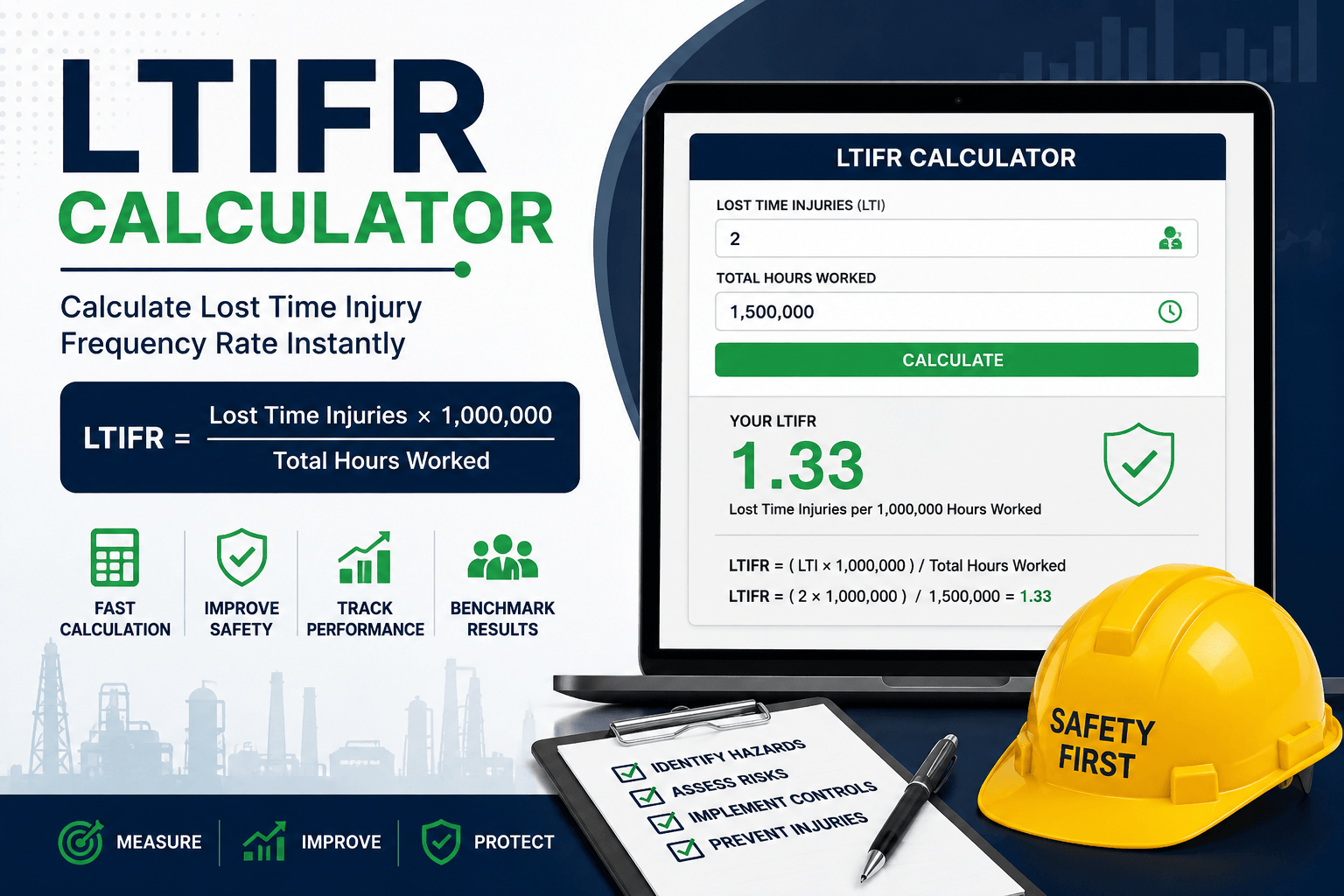
Use this free LTIFR Calculator to determine your Lost Time Injury Frequency Rate based on the total number of lost time injuries and total hours worked.
LTIFR Calculator
Enter your lost time injuries and total hours worked to calculate your Lost Time Injury Frequency Rate (LTIFR).
What is LTIFR?
Lost Time Injury Frequency Rate (LTIFR) is a commonly used health and safety KPI that measures how many lost time injuries occur for every one million hours worked. Organizations use LTIFR to monitor safety performance, identify trends and benchmark against previous periods or industry averages.
Why LTIFR Matters
LTIFR is one of the most widely used health and safety KPIs. Organizations use it to measure workplace safety performance and compare results across projects, contractors and industries.
What is considered a lost time injury?
A lost time injury is a work-related injury or illness that causes an employee to miss at least one scheduled workday or shift.
LTIFR Formula
LTIFR = (Lost Time Injuries × 1,000,000) ÷ Total Hours WorkedExample Calculation
Lost Time Injuries: 2
Total Hours Worked: 1,500,000
LTIFR = (2 × 1,000,000) ÷ 1,500,000

LTIFR = 1.33
Understanding Your Result
| LTIFR | General Interpretation |
|---|---|
| 0 | No lost time injuries recorded |
| Below 1 | Very good safety performance |
| 1–3 | Moderate performance, monitor trends |
| Above 3 | Indicates opportunity for safety improvement |
However, acceptable values vary by industry and organization.
How to Reduce LTIFR
- Conduct regular workplace inspections.
- Improve hazard identification and risk assessments.
- Deliver effective toolbox talks.
- Investigate all incidents and near misses.
- Verify competency before high-risk work.
- Encourage reporting of unsafe conditions.
- Review leading indicators alongside LTIFR.