
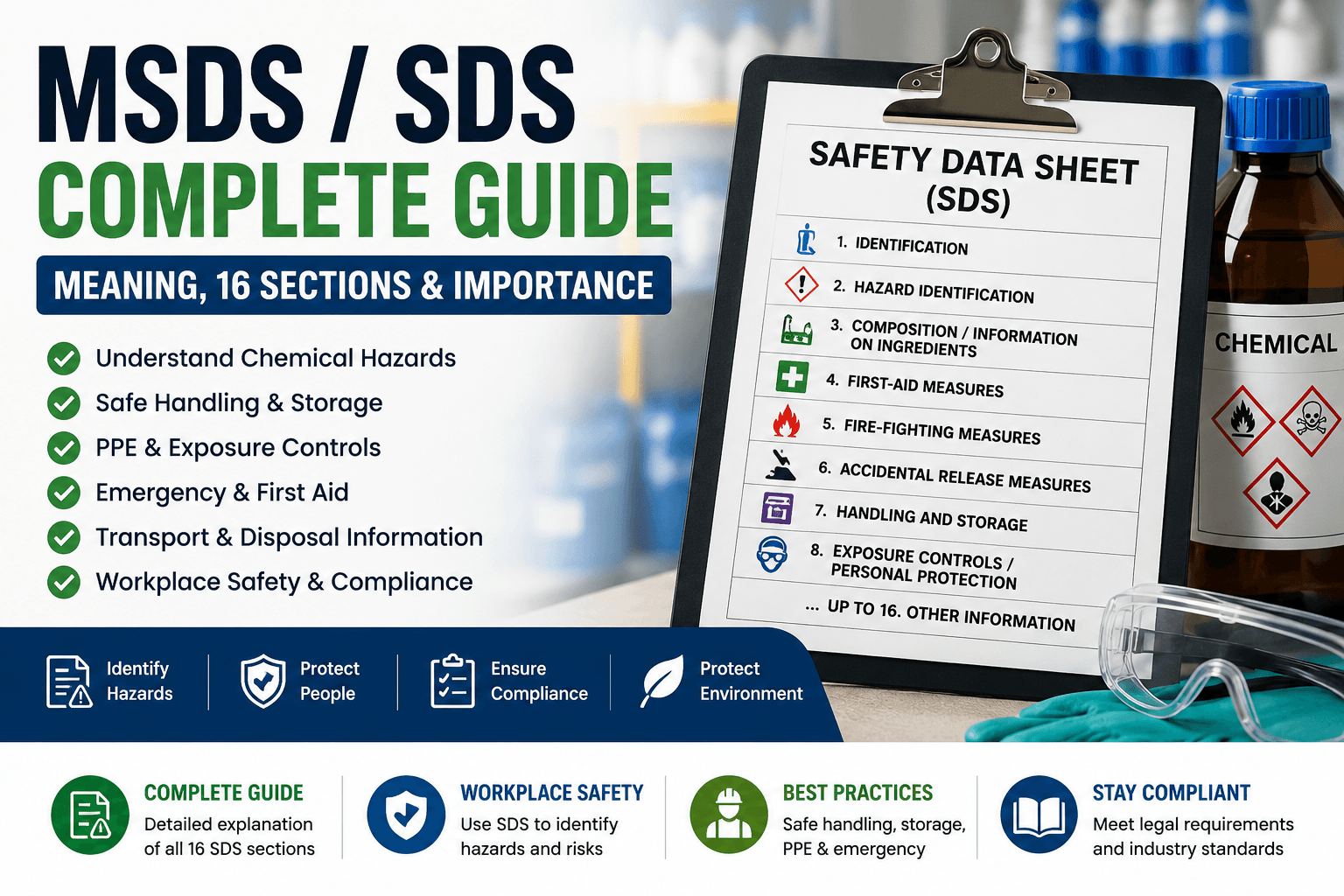
A Material Safety Data Sheet (MSDS) is a document that provides important information about a chemical product, including its hazards, safe handling and storage requirements, exposure controls, emergency measures, and disposal considerations.
The term Safety Data Sheet (SDS) is now commonly used for standardized chemical safety information, while MSDS remains a widely used search term and is still commonly used in workplaces.
Manufacturers, importers and suppliers of hazardous chemicals are responsible for providing appropriate safety information for the chemicals they supply. Employers should ensure that workers can access the relevant SDS/MSDS information and understand the hazards associated with the chemicals they use.
This guide explains what an MSDS/SDS is, the information it contains, how it is used in the workplace, and why it is important for HSE professionals and workers handling chemicals.
What is an MSDS?
MSDS stands for Material Safety Data Sheet.
It provides information needed to safely use, store, handle and transport a chemical product.
An MSDS/SDS can help workers and emergency responders understand:
- Chemical hazards
- Health effects
- Fire hazards
- Required PPE
- Safe handling procedures
- Storage requirements
- First-aid measures
- Spill and leak response
- Exposure controls
- Disposal requirements
- Transport information
MSDS vs SDS: What Is the Difference?
MSDS and SDS refer to essentially the same type of chemical safety document, but SDS is the modern standardized terminology.
Older MSDS formats could vary considerably between manufacturers. Modern SDS formats use a standardized 16-section structure, making it easier for workers and emergency responders to locate important information.
MSDS = Material Safety Data Sheet
SDS = Safety Data Sheet
What are the 16 Sections of an MSDS/SDS?
Modern Safety Data Sheets generally contain the following 16 sections:
1. Identification
Provides information about the chemical/product, recommended uses, restrictions on use, supplier details and emergency contact information.
2. Hazard Identification
Identifies the hazards associated with the chemical and provides relevant hazard classifications, signal words, hazard statements and precautionary statements.
3. Composition/Information on Ingredients
Provides information about the chemical ingredients and, where applicable, their concentrations or concentration ranges.
4. First-Aid Measures
Explains the appropriate first-aid measures following exposure through inhalation, skin contact, eye contact or ingestion.
5. Fire-Fighting Measures
Provides information about suitable extinguishing media, specific hazards arising from the chemical and recommendations for firefighters.
6. Accidental Release Measures
Provides procedures and precautions for responding to spills, leaks or accidental releases.
7. Handling and Storage
Describes safe handling practices and appropriate storage conditions, including incompatible materials where relevant.
8. Exposure Controls/Personal Protection
Provides applicable exposure limits, engineering controls and recommended personal protective equipment.
9. Physical and Chemical Properties
Provides relevant properties such as appearance, odour, pH, melting/freezing point, boiling point, flash point and other applicable characteristics.
10. Stability and Reactivity
Explains the chemical’s stability, conditions to avoid, incompatible materials and hazardous reactions or decomposition products.
11. Toxicological Information
Provides information about potential health effects and routes of exposure, along with relevant toxicological data.
12. Ecological Information
Provides information about environmental effects and relevant ecological properties.
13. Disposal Considerations
Provides recommendations for the safe disposal of the chemical, contaminated materials and containers.
14. Transport Information
Provides information relevant to the transportation of the chemical, including applicable transport classifications where required.
15. Regulatory Information
Provides relevant regulatory information applicable to the chemical.
16. Other Information
Contains additional information such as preparation or revision dates and other information relevant to the SDS.
Why an MSDS/SDS Important?
An MSDS/SDS is an important source of information for workplace chemical safety.
HSE professionals can use it to:
- Identify chemical hazards
- Select appropriate PPE
- Establish safe handling procedures
- Determine suitable storage conditions
- Prepare emergency response procedures
- Assess chemical exposure risks
- Develop risk assessments and method statements
- Train workers
- Respond to chemical spills
- Support workplace emergency planning
How an MSDS Used in a Workplace?
Before workers use a hazardous chemical, they should have access to the relevant safety information.
An HSE professional may use the SDS when preparing:
- Chemical risk assessments
- Job Safety Analyses (JSA)
- Safe Work Method Statements (SWMS)
- Emergency response procedures
- Chemical storage arrangements
- PPE requirements
- Spill response procedures
- Worker training
For example, if a worker needs to use a solvent, the SDS can help determine the chemical’s hazards, required ventilation, appropriate gloves and eye protection, exposure controls, first-aid measures and spill-response requirements.
Where Can You Get an MSDS/SDS?
The SDS should normally be obtained from the manufacturer, importer, supplier or other responsible source for the chemical product.
When purchasing or receiving a hazardous chemical, verify that the relevant safety information is available and corresponds to the specific product.
Avoid relying on an unrelated SDS found through a general internet search because formulations and hazards can differ between products.
What Should an HSE Officer Check on an MSDS?
An HSE Officer should pay particular attention to:
- Product identification
- Hazard classification
- Composition
- Exposure limits
- Required PPE
- First-aid requirements
- Fire-fighting measures
- Spill-response procedures
- Storage requirements
- Incompatible materials
- Toxicological information
- Disposal requirements
- Transport information
- Revision date
The revision date is particularly useful when checking whether the document is current.