
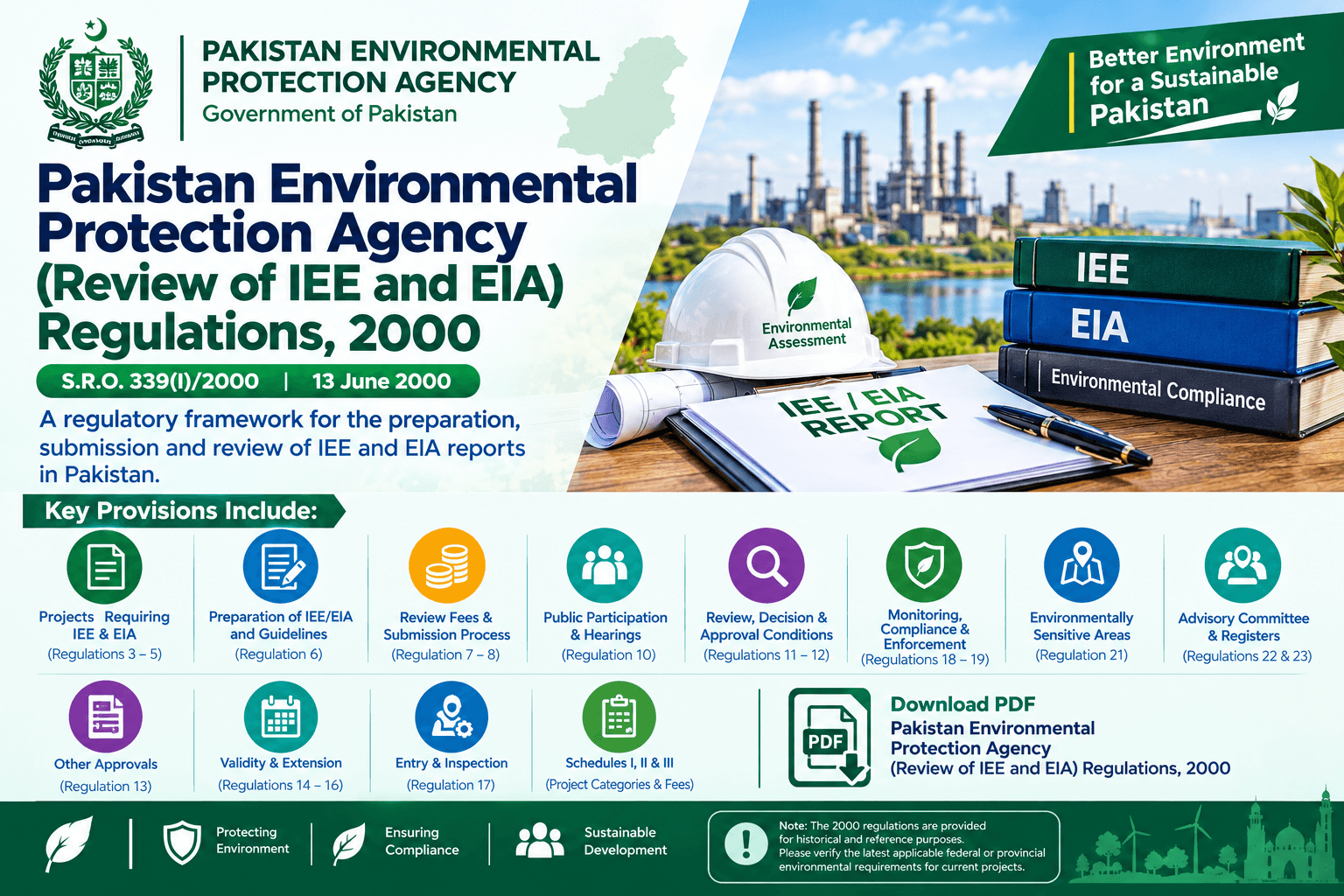
The Pakistan Environmental Protection Agency (Review of Initial Environmental Examination and Environmental Impact Assessment) Regulations, 2000 provide the regulatory framework for the preparation, submission and review of Initial Environmental Examination (IEE) and Environmental Impact Assessment (EIA) reports in Pakistan.
The regulations classify projects according to their potential environmental impacts and specify which projects require an IEE or EIA.
Key Regulations
Regulation 1 – Short Title and Commencement
Provides the title of the regulations and states that they come into force at once.
Regulation 2 – Definitions
Defines important terms including IEE, EIA, Director-General, Schedule and Section.
Regulation 3 – Projects Requiring an IEE
Requires projects falling within the categories listed in Schedule I to file an IEE with the Federal Agency.
Regulation 4 – Projects Requiring an EIA
Requires projects falling within Schedule II to file an EIA with the Federal Agency.
Regulation 5 – Other Projects Requiring an IEE or EIA
Allows the Federal Agency to require an IEE or EIA for projects not specifically listed in the schedules where environmental impacts may warrant assessment.
Regulation 6 – Preparation of IEE and EIA
Provides for preparation of IEE and EIA reports in accordance with applicable general and sectoral guidelines.
Regulation 7 – Review Fees
Requires payment of the applicable non-refundable review fee.
Regulation 8 – Filing of IEE and EIA
Specifies submission requirements, including copies of the assessment report, application and proof of payment.
Regulation 9 – Preliminary Scrutiny
Provides for preliminary examination of submitted IEE/EIA documents and requests for additional information or revision.
Regulation 10 – Public Participation
Provides for public notice, public hearings and consideration of comments for EIA projects.
Regulation 11 – Review
Sets the review process, including a target of 45 days for IEE and 90 days for EIA after confirmation of completeness.
Regulation 12 – Decision
Provides for communication of the Federal Agency’s decision following review.
Regulation 13 – Conditions of Approval
Requires approved projects to comply with the approved IEE/EIA and specified mitigation measures.
Regulation 14 – Confirmation of Compliance
Provides for an Environmental Management Plan and confirmation of compliance before commencement of operation.
Regulation 15 – Extension in Review Period
Deals with extension of the review period in particular cases.
Regulation 16 – Validity Period of Approval
Specifies the validity periods of environmental approval and provisions for extension.
Regulation 17 – Entry and Inspection
Allows authorized Federal Agency staff to inspect project sites, buildings, plants and equipment.
Regulation 18 – Monitoring
Requires post-construction and annual operational reports for monitoring compliance with approval conditions.
Regulation 19 – Cancellation of Approval
Provides for cancellation of approval where conditions are not complied with or information supplied in the IEE/EIA is incorrect.
Regulation 20 – Registers for IEE and EIA Projects
Requires separate registers to be maintained for IEE and EIA projects.
Regulation 21 – Environmentally Sensitive Areas
Provides that projects located in designated environmentally sensitive areas require an EIA.
Regulation 22 – Environmental Assessment Advisory Committee
Provides for an advisory committee dealing with environmental assessment guidelines, procedures and project categorization.
Regulation 23 – Other Approvals
Clarifies that environmental approval does not remove the requirement to obtain other approvals or consents required under applicable laws.
Schedules
The regulations contain three important project/administrative schedules:
- Schedule I – Projects Requiring an IEE
- Schedule II – Projects Requiring an EIA
- Schedule III – Review Fees
Schedule I includes categories such as energy, manufacturing, mining, transport, water management, water supply, waste disposal and urban development. Schedule II covers projects with potentially more significant environmental impacts, including large power projects, cement and chemical plants, major roads, airports, hazardous-waste facilities and projects in environmentally sensitive areas.