
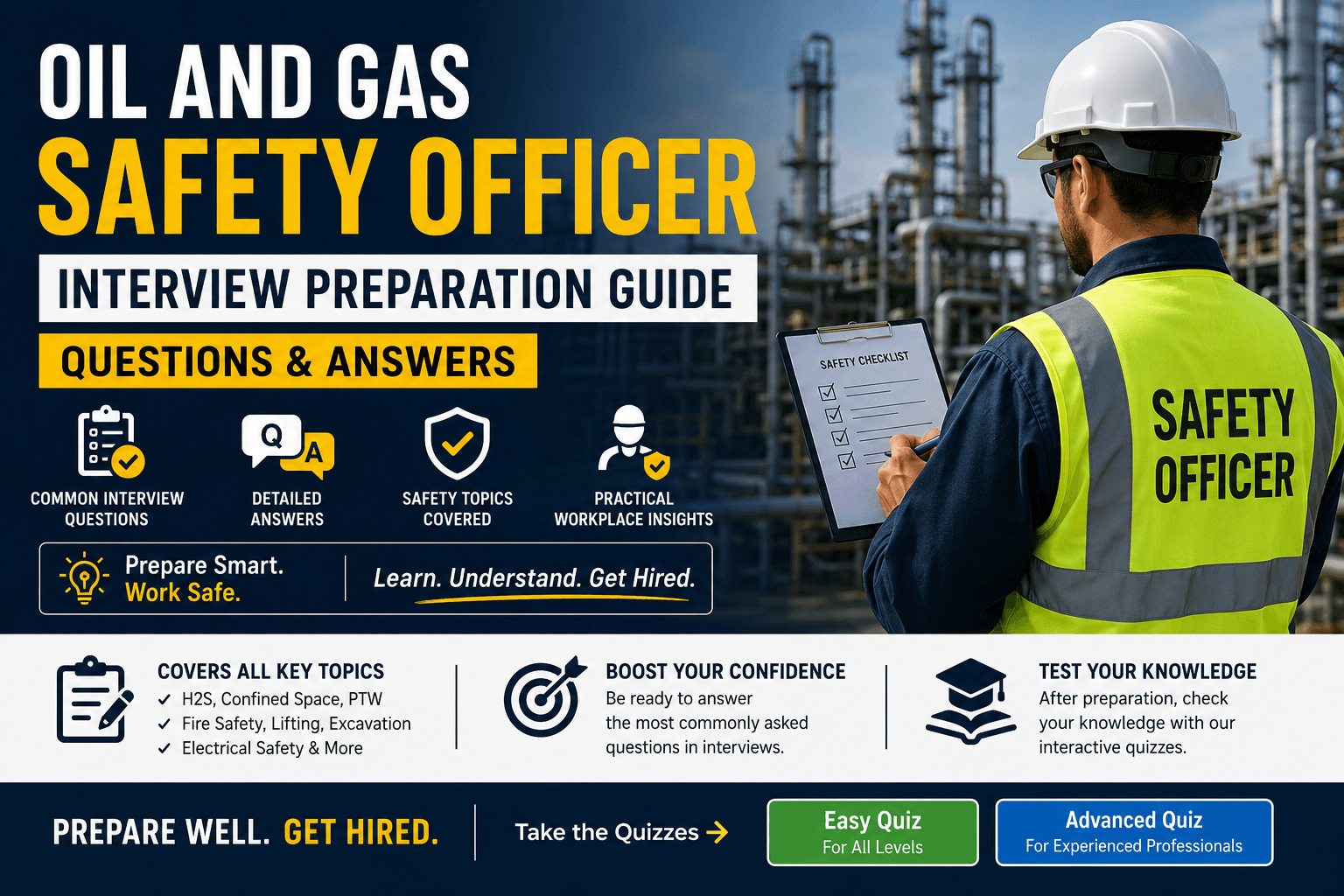
Preparing for an Oil and Gas Safety Officer interview requires more than memorizing safety definitions. Interviewers usually assess your practical understanding of hazards, control measures, permit systems, emergency response, and safe work practices used at operational sites.
Oil and gas facilities involve high-risk activities such as H2S exposure, confined space entry, hot work, lifting operations, excavation, pressure testing, and hazardous material handling. A Safety Officer must understand these hazards and ensure that proper controls are implemented before work begins.
This guide covers commonly asked Oil and Gas Safety Officer interview questions and answers to help HSE professionals prepare for interviews with Oil and Gas companies, construction companies, EPC contractors, refineries, petrochemical plants, and oil field operations.
This guide also covers interview preparation for HSE and Safety Officer positions in major oil and gas markets including the UAE, Saudi Arabia and Qatar, including roles with major energy companies and their contractors.
After reviewing these interview questions and answers, test your knowledge by attempting our:
Easy Quiz
Ideal for beginners, fresh graduates, and those preparing for entry-level HSE interviews.
Advanced Quiz
Designed for Safety Officers and candidates preparing for technical Oil & Gas HSE interviews.
The quizzes will help you identify areas where further preparation is required.
Table of Contents
H2S (Hydrogen Sulfide)
Question – What is H2S?
Answer: H2S (Hydrogen Sulfide) is a colorless, highly toxic, flammable gas with a characteristic rotten egg smell at low concentrations. It is slightly heavier than air and can accumulate in low-lying areas such as pits, trenches, drains, and confined spaces.
H2S is dangerous because high concentrations can quickly affect the nervous system and may cause loss of smell, unconsciousness, or death.
Question – What is the difference between sour gas and sweet gas?
Answer: Sour gas contains significant amounts of hydrogen sulfide (H2S), while sweet gas contains little or no H2S.
Sour gas requires additional controls because H2S exposure can create a serious health hazard.
Question – Why should workers not rely on smell to detect H2S?
Answer: Although H2S may smell like rotten eggs at low concentrations, high concentrations can quickly disable the sense of smell.
Therefore, workers should always rely on gas detectors and monitoring equipment, not their nose.
Question – Is H2S flammable or toxic?
Answer: H2S is both toxic and flammable.
It can cause serious health effects due to toxicity and can form an explosive mixture when combined with air.
Question – What precautions are required when working in an H2S area?
Answer: Important precautions include:
- Complete H2S awareness training
- Perform gas testing before work
- Use appropriate PPE
- Carry personal gas detectors where required
- Understand wind direction and muster points
- Follow Permit to Work requirements
- Use breathing apparatus when required by risk assessment
Confined Space
Question – What is a confined space?
Answer: A confined space is an enclosed or partially enclosed area that:
- Has limited entry and exit points
- Is large enough for a person to enter
- Is not designed for continuous human occupancy
Examples include tanks, vessels, pits, boilers, and underground chambers.
Question – What are the main hazards of confined space entry?
Answer: Common hazards include:
- Oxygen deficiency
- Toxic gases such as H2S
- Flammable atmosphere
- Engulfment
- Restricted movement
- Heat stress
- Difficulty in rescue
Question – What safety precautions are required before confined space entry?
Answer: Before entry:
- Obtain approved confined space permit
- Complete risk assessment
- Isolate the equipment
- Ventilate the space
- Perform atmospheric testing
- Verify oxygen and gas levels
- Conduct toolbox talk
- Assign a trained standby person
- Ensure rescue arrangements are available
Question – What is the minimum oxygen level required for confined space entry?
Answer: The minimum acceptable oxygen level is generally 19.5%.
Entry should not be allowed below this level until corrective actions are completed.
Permit to Work (PTW)
Question – What is Permit to Work?
Answer: Permit to Work is a formal control system used to ensure hazardous work is properly planned, hazards are identified, controls are implemented, and authorization is given before work begins.
Question – What are common types of work permits in Oil and Gas?
Answer: Common permits include:
- Hot Work Permit
- Cold Work Permit
- Confined Space Entry Permit
- Excavation Permit
- Electrical Isolation Permit
- Work at Height Permit (where applicable)
Question – Does a Permit to Work replace a Risk Assessment?
Answer: No. A Permit to Work does not replace a risk assessment. The risk assessment identifies hazards and controls, while the permit confirms that required precautions are implemented before work starts.
Task Risk Assessment (TRA)
Question – What is the difference between hazard and risk?
Answer: A hazard is anything that has the potential to cause harm.
Risk is the likelihood and severity of harm resulting from that hazard.
Example:
Electricity is a hazard.
Electric shock or burns are risks.
Question – Why is Task Risk Assessment important?
Answer: TRA helps identify hazards before starting work and ensures appropriate control measures are implemented to prevent incidents.
Working at Height
Question – At what height is a safety harness required?
Answer: In many oil and gas industries, a full body harness becomes mandatory when working at heights above 2 meters.
The worker must be properly connected to a suitable anchorage point using an approved fall protection system.
Question – What PPE is required for working at height?
Answer: Typical PPE requirements include:
- Full body harness
- Safety helmet with chin strap
- Safety shoes
- Gloves
- Eye protection depending on the task
Additional PPE may be required based on the activity and risk assessment.
Question – What are the main hazards of working at height?
Answer: The main hazards include:
- Falls from height causing serious injury or death
- Falling tools and materials
- Damage to equipment below
- Unstable working platforms
Proper planning, inspection, and fall protection systems are required to control these hazards.
Personal Protective Equipment (PPE)
Question – What is PPE?
Answer: PPE is equipment worn by workers to protect them from hazards that cannot be completely eliminated through engineering or administrative controls.
PPE is considered the last line of defense.
Question – What is the minimum PPE required on an oil and gas site?
Answer: Typical minimum PPE includes:
- Safety helmet
- Safety boots
- Safety glasses
- Gloves
- Coveralls/high visibility clothing (as required by site rules)
Additional PPE depends on the task hazards.
Question – What additional PPE is required for welding activities?
Answer: Welders require task-specific PPE including:
- Welding helmet with suitable shade lens
- Welding gloves
- Flame-resistant clothing
- Welding safety boots
- Respiratory protection where required
- Full body harness when working at height
Portable Gas Detection
Question – Why is gas monitoring required in oil and gas operations?
Answer: Many hazardous gases in oil and gas facilities are invisible and cannot be detected by human senses.
Gas monitoring helps identify toxic, flammable, or oxygen-deficient atmospheres before they become dangerous.
Question – What does a portable gas detector measure?
Answer: A typical multi-gas detector measures:
- Oxygen concentration (%)
- Flammable gases (%LEL)
- Hydrogen sulfide (H2S) in ppm
- Carbon monoxide (CO) in ppm
Question – Can a worker rely on smell to detect hazardous gases?
Answer: No. Some gases cannot be detected by smell, and gases like H2S can quickly disable the sense of smell at higher concentrations.
Gas detectors must always be used.
Emergency Response
Question – What actions should be taken during a gas leak?
Answer: During a gas release:
- Stop the work
- Move away from the affected area
- Check wind direction
- Move crosswind and then upwind if required
- Report the emergency
- Proceed to the designated muster point
Do not attempt rescue without proper training and breathing equipment.
Question – What is the importance of knowing wind direction in oil and gas facilities?
Answer: Wind direction helps workers move away from toxic gas clouds.
During a gas release, personnel should avoid moving downwind where the gas concentration may be higher.
Fire Safety
Question – What are the main classes of fire?
Answer: Common fire classes include:
- Class A: Ordinary combustible materials such as wood and paper
- Class B: Flammable liquids
- Class C: Flammable gases
- Class D: Combustible metals
- Electrical fires (often treated separately depending on local classification)
Question – Which fire extinguisher is suitable for electrical fires?
Answer: CO₂ fire extinguishers are commonly used for electrical fires because they are non-conductive and leave no residue.
Question – Can a fire extinguisher with a broken safety seal be used?
Answer: No. A broken seal may indicate that the extinguisher has been used or tampered with. It should be inspected before being returned to service.
Welding and Hot Work
Question – What hazards are associated with welding and cutting?
Answer: Common hazards include:
- Fire and explosion
- Burns from hot surfaces
- Arc eye from ultraviolet radiation
- Welding fumes
- Gas cylinder hazards
- Electric shock
Question – What precautions are required before hot work?
Answer: Before starting hot work:
- Obtain approved hot work permit
- Perform gas testing
- Remove combustible materials
- Provide fire extinguishers
- Install fire blankets/screens
- Assign a trained fire watch
- Verify welding equipment condition
Question – Why is gas testing required before hot work?
Answer: Gas testing confirms that no flammable atmosphere exists before producing sparks or flames.
Even small concentrations of flammable gases can create a fire or explosion hazard.
Question – Why should gas cylinders not be placed inside confined spaces?
Answer: Gas cylinders inside confined spaces increase the risk of:
- Fire
- Explosion
- Toxic gas release
- Oxygen displacement
Cylinders should remain outside the confined space whenever possible.
Test Your Knowledge
After completing these interview questions, check your understanding by attempting:
Easy Quiz
Ideal for beginners, fresh graduates, and those preparing for entry-level HSE interviews.
Advanced Quiz
Designed for Safety Officers and candidates preparing for technical Oil & Gas HSE interviews.
The quizzes include practical questions to help identify your strengths and areas requiring further preparation.
Lifting Operations
Question – Why are test certificates required for lifting equipment?
Answer: Test certificates confirm that lifting equipment has been inspected and tested by a competent and authorized person.
They verify that equipment such as cranes, slings, shackles, and lifting accessories are safe for the intended use.
Question – Who can issue a lifting equipment test certificate?
Answer: A test certificate should be issued by a competent and authorized inspection body or person approved to perform lifting equipment examinations.
Question – What does SWL mean?
Answer: SWL stands for Safe Working Load.
It is the maximum load that lifting equipment can safely handle under specified conditions.
Before lifting, factors such as:
- Load weight
- Crane capacity
- Boom radius
- Sling capacity
- Lifting accessories
must be verified.
Question – What controls are required before a lifting operation?
Answer: Before lifting:
- Prepare a lifting plan
- Verify crane and lifting equipment certification
- Confirm operator and rigger competency
- Check SWL
- Inspect lifting accessories
- Establish an exclusion zone
- Use tag lines where required
- Assign a trained signalman
Question – Why is a lifting exclusion zone required?
Answer: A lifting exclusion zone prevents unauthorized personnel from entering the danger area where they may be struck by a suspended load or falling objects.
Excavation Safety
Question – What are the main hazards of excavation?
Answer: Major excavation hazards include:
- Collapse of excavation walls
- Damage to underground utilities
- Falls of people or equipment into excavation
- Water accumulation/flooding
- Hazardous gas accumulation
Question – What should be done before starting excavation?
Answer: Before excavation:
- Obtain excavation permit
- Review drawings
- Identify underground utilities
- Complete risk assessment
- Inspect excavation area
- Assign competent supervision
Question – Why must underground utilities be identified before excavation?
Answer: Underground cables, pipelines, and services can cause:
- Electrocution
- Gas release
- Fire or explosion
- Service disruption
Question – How far should excavated soil be kept from the edge?
Answer: Excavated material should generally be kept at least 1.5 meters away from the excavation edge.
This reduces additional loading and collapse risk.
Compressed Gas Cylinders
Question – What are the main hazards of compressed gas cylinders?
Answer: Hazards include:
- Explosion
- Fire
- Gas leakage
- Cylinder rupture
- Oxygen enrichment
- Incorrect handling
Question – How should gas cylinders be stored?
Answer: Gas cylinders should be:
- Stored upright and secured
- Protected from damage
- Separated according to gas type
- Kept away from direct sunlight and heat sources
- Clearly identified
Question – Can gas cylinders be transported by rolling them on the ground?
Answer: No. Cylinders should be transported using suitable cylinder trolleys and secured properly.
Question – What precautions are required when using oxygen and fuel gas cylinders?
Answer: Required controls include:
- Check cylinder condition
- Use correct regulators
- Install flashback arrestors
- Check hoses for leaks
- Keep cylinders away from ignition sources
- Close valves when not in use
Scaffolding Safety
Question – What is scaffolding?
Answer: Scaffolding is a temporary structure made from tubes, couplers, and platforms that provides safe access and working platforms at height.
Question – Who can modify scaffolding?
Answer: Only qualified and competent scaffolders should modify scaffolding.
Untrained workers must not make alterations.
Question – What is the purpose of a toe board?
Answer: A toe board prevents:
- Tools and materials falling from platforms
- Workers’ feet slipping over platform edges
Question – How many people can climb a ladder at one time?
Answer: Normally only one person should climb a ladder at a time unless the ladder is specifically designed otherwise.
Electrical Safety
Question – What precautions are required before working on an electrical panel?
Answer: Before electrical work:
- Obtain required permit
- Isolate electrical supply
- Apply Lock Out Tag Out (LOTO)
- Verify isolation
- Use appropriate PPE
- Ensure competent electrical personnel perform the work
Question – Why are 110V tools commonly used on construction sites?
Answer: 110V tools reduce the severity of electric shock compared with higher voltage systems and are commonly used where temporary power is required.
Question – Who should work on electrical equipment?
Answer: Only competent and authorized electrical personnel should perform electrical work, especially on energized systems.
Near Miss
Question – What is a near miss?
Answer: A near miss is an event that could have caused injury, property damage, environmental impact, or production loss but did not result in actual harm.
Question – Why is near miss reporting important?
Answer: Near miss reporting helps organizations:
- Identify hazards
- Correct unsafe conditions
- Prevent future incidents
- Improve safety performance
Test Your Knowledge
After preparing these interview questions, check your understanding with:
Easy Quiz
Ideal for beginners, fresh graduates, and those preparing for entry-level HSE interviews.
Advanced Quiz
Designed for Safety Officers and candidates preparing for technical Oil & Gas HSE interviews.
The advanced quiz includes scenario-based questions similar to situations Safety Officers face at real oil and gas worksites.
Hazardous Materials (MSDS/SDS)
Question – What is MSDS?
Answer: MSDS stands for Material Safety Data Sheet.
It is a document provided by the chemical manufacturer containing important information about:
- Chemical hazards
- Required PPE
- Safe handling and storage
- First aid measures
- Firefighting methods
- Spill response procedures
Many industries now use the term SDS (Safety Data Sheet) instead of MSDS.
Question – Why is SDS important before using a chemical?
Answer: SDS helps workers understand the hazards associated with a chemical and the required control measures before starting work.
Workers should review SDS information before handling unfamiliar chemicals.
Question – What information can be found in an SDS?
Answer: An SDS normally includes:
- Chemical identification
- Hazard classification
- Required PPE
- Exposure limits
- First aid measures
- Storage requirements
- Emergency response information
SCBA (Self Contained Breathing Apparatus)
Question – What is SCBA?
Answer: SCBA stands for Self Contained Breathing Apparatus.
It provides breathable air from a cylinder carried by the user and is used when the atmosphere cannot support normal breathing.
Question – When is SCBA required?
Answer: SCBA is required when:
- Toxic gases such as H2S are present
- Oxygen levels are unsafe
- The atmosphere is unknown
- Emergency rescue operations are required
Question – Can a person with a beard use SCBA?
Answer: A proper face seal is required for SCBA effectiveness.
Beards or facial hair can prevent a tight seal and allow contaminated air to enter the mask.
Question – Can an SCBA trolley set be used as an escape device?
Answer: No. An SCBA trolley set is designed to supply breathing air during work activities but is not intended for emergency escape.
Hydrotesting and Pressure Testing
Question – What are the hazards of hydrotesting?
Answer: Hazards include:
- Sudden release of pressure
- Equipment failure
- Flying objects
- Water discharge/flooding
- Damage to surrounding equipment
Question – What controls are required during pressure testing?
Answer: Controls include:
- Verify test pressure limits
- Barricade the test area
- Keep unauthorized personnel away
- Inspect equipment before testing
- Use approved pressure relief systems
- Monitor the test continuously
Question – Why is pneumatic testing more dangerous than hydrotesting?
Answer: Pneumatic testing uses compressed gas, which stores much more energy than water.
Failure during pneumatic testing can result in a violent release of energy and flying debris.
Radiography Safety
Question – Why is radiography considered a high-risk activity?
Answer: Radiography involves ionizing radiation that can cause serious health effects if workers are exposed without proper controls.
Question – What precautions are required during radiography?
Answer: Controls include:
- Approved permit
- Qualified radiographers
- Barricaded exclusion zone
- Warning signs and lights
- Radiation monitoring equipment
- Removal of unauthorized personnel
Question – Can other work continue near radiography activities?
Answer: No. The area must be controlled and unauthorized activities should not continue within the radiation exclusion zone.
Grit Blasting Safety
Question – What PPE is required for grit blasting?
Answer: Typical PPE includes:
- Approved blasting hood
- Supplied breathing air system
- Protective gloves
- Protective clothing/apron
- Safety boots
Question – What checks should be completed before grit blasting?
Answer: Before starting:
- Verify permit requirements
- Inspect blasting equipment
- Check hoses and connections
- Install whip lash protection
- Establish barricaded work area
- Confirm PPE availability
Housekeeping Safety
Good housekeeping is an important part of preventing workplace incidents.
Question – Why is good housekeeping important?
Answer: Good housekeeping helps prevent:
- Slips, trips and falls
- Fire hazards
- Blocked emergency access
- Material damage
- Poor workplace conditions
Question – How does proper material stacking improve safety?
Answer: Proper stacking:
- Improves access and movement
- Prevents falling materials
- Reduces damage
- Keeps work areas organized
Refueling Safety
Question – What are the main hazards during refueling?
Answer: Hazards include:
- Fire
- Explosion
- Fuel spills
- Environmental contamination
- Static ignition
Question – What precautions should be taken during refueling?
Answer: Required controls include:
- Switch off equipment before refueling
- Remove ignition sources
- Use suitable fuel hoses
- Prevent spills
- Supervise the activity
- Keep firefighting equipment available
Final Oil and Gas Safety Officer Interview Preparation Tips
Before attending an interview, make sure you understand:
- Permit to Work system
- Task Risk Assessment
- H2S hazards and response
- Confined space requirements
- Hot work controls
- Gas testing procedures
- Lifting safety
- Excavation controls
- Electrical isolation and LOTO
- Emergency response procedures
Interviewers are usually not only looking for definitions. They want to know whether you can identify hazards, apply the hierarchy of controls, and make safe decisions in real workplace situations.
Oil and Gas Safety Officer Interview Preparation for GCC Jobs
Oil and gas HSE professionals applying for positions in the Gulf region may encounter additional questions related to the specific operating environment, client requirements and project standards. Candidates should be prepared to demonstrate practical knowledge rather than simply provide textbook definitions.
ADNOC Safety Officer Interview Questions – UAE
Following are the potential questions for ADNOC Safety Officer interview:
- What are ADNOC’s 10 Life-Saving Rules?
- What does ADNOC require regarding energy isolation and zero energy before work begins?
- What is ADNOC’s requirement for working in toxic gas environments and controlling flammable/ignition sources?
Candidates who are considering a NEBOSH or IOSH qualification in United Arab Emirates before applying for HSE positions can also see the accredited NEBOSH Learning Partners in UAE or verified IOSH centers in UAE.
QatarEnergy Safety Officer Interview Questions – Qatar
- What are QatarEnergy’s 12 Life-Saving Rules?
- What is QatarEnergy’s requirement for the Permit to Work system?
- What should a Safety Officer do if an unsafe act or condition is identified on a QatarEnergy project?
Candidates who are considering a NEBOSH or IOSH qualification in Qatar before applying for HSE positions can also see the accredited NEBOSH Learning Partners in Qatar or verified IOSH centers in Qatar.
Saudi Aramco Safety Officer Interview Questions – Saudi Arabia
- What are Saudi Aramco’s 8 Life-Saving Rules?
- What precautions are required before entering a confined space on an Aramco project?
- What controls should be verified before work involving energy isolation, work at height or excavation begins?
Candidates who are considering a NEBOSH or IOSH qualification in Saudi Arabia before applying for HSE positions can also see the accredited NEBOSH Learning Partners in Saudi Arabia or verified IOSH centers in Saudi Arabia.
Test Your Knowledge After Preparation
After reviewing these interview questions and answers, test yourself with our Oil and Gas Safety Officer quizzes:
The easy quiz is suitable for candidates starting their preparation, while the advanced quiz contains scenario-based questions designed for experienced HSE professionals.