
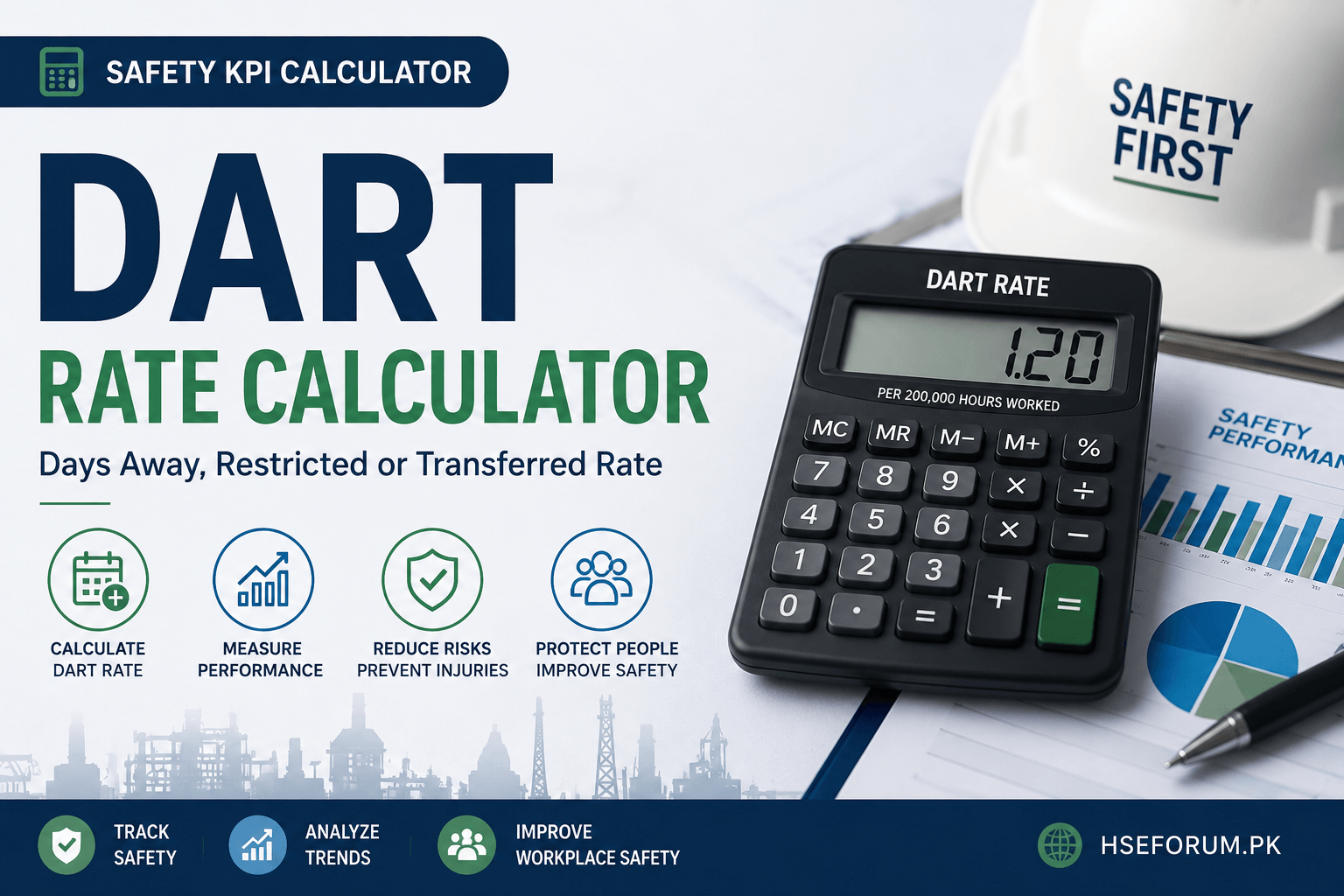
Use this free DART Rate Calculator to quickly calculate your organization’s Days Away, Restricted or Transferred (DART) Rate. Simply enter the total number of DART cases and the total hours worked during the reporting period to calculate your DART Rate instantly.
The DART Rate is a widely used workplace safety performance indicator that helps organizations monitor serious work-related injuries and illnesses resulting in days away from work, restricted duties, or job transfers.
DART Rate Calculator
Enter the total number of DART cases and total hours worked to calculate your Days Away, Restricted or Transferred (DART) Rate.
What is DART Rate?
The Days Away, Restricted or Transferred (DART) Rate measures the number of work-related injuries and illnesses that resulted in:
- Days away from work
- Restricted work activity
- Job transfer
per 200,000 employee work hours, which represents 100 full-time employees working one year.
DART Rate Formula
DART Rate = (DART Cases × 200,000) ÷ Total Hours WorkedWhere:
- DART Cases = Total cases involving days away, restricted work, or job transfer.
- 200,000 = Standard OSHA base for 100 full-time employees.
- Total Hours Worked = Total employee hours worked during the reporting period.
Example Calculation
Suppose a company recorded:
- DART Cases: 3
- Hours Worked: 500,000
Calculation:
(3 × 200,000) ÷ 500,000

DART Rate = 1.20
Why is DART Rate Important?
Monitoring DART Rate helps organizations:
- Measure workplace safety performance.
- Track trends over time.
- Benchmark against industry averages.
- Identify areas requiring additional risk controls.
- Support safety reporting and continuous improvement.